


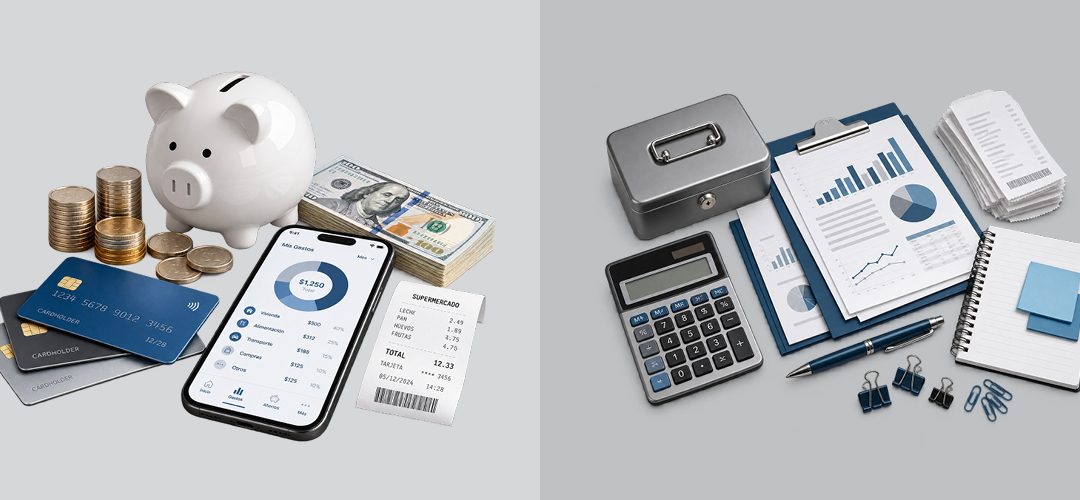
In previous #SilverTalks, we analyzed why a company can be profitable on paper and still face liquidity problems. This time, we address one of the most common causes of that situation among Dominican MSMEs: the mixing of the owner's personal finances with those of the business.
Micro, small, and medium-sized enterprises (MSMEs) form the backbone of the country's productive base. According to the 2022-2023 National MSME Survey, conducted by the Central Bank and the Ministry of Industry, Commerce and MSMEs, these businesses contribute about one third of GDP (32%) and generate most of the country's employment. However, they are also markedly fragile: 85.2% operate informally, without full access to the financial instruments that would allow them to grow.
In this article, we will explore how this practice affects MSMEs, other common financial mistakes, and the measures that help avoid them.
What Does Mixing Personal and Business Finances Involve?
Confusing the owner's assets with those of the company is probably the most widespread financial mistake among MSMEs and the root of many others. It shows up when household expenses are covered with business income, when company obligations are paid with personal instruments, or when the owner's contributions and withdrawals are not properly recorded.
This reality is reflected in how businesses are financed. According to the report Caracterización de las mipymes (Characterization of MSMEs), published by the National Statistics Office (ONE) in 2023 using data from the Enhogar 2022 survey, MSMEs that rely on personal loans (11.5%) nearly double those that use commercial loans (6.4%). In other words, when an MSME seeks financing, it most often does so in the owner's name rather than the company's.
The impact of this practice extends to several dimensions of the business:
- Measuring profitability: when personal expenses are recorded as operating expenses, the financial statements no longer reflect the business's actual performance, and the ability to evaluate margins and prices is lost.
- Access to financing: according to a 2025 report by the Superintendency of Banks, among MSMEs whose credit applications were rejected, the predominant causes were lack of credit history (36%) and insufficient income (27%). A company without its own accounts can hardly build a credit history or demonstrate its ability to repay.
- Protection of family assets: without a clear boundary, business risks are transferred directly to the personal assets of the owner and their family.
- Tax compliance: without separate records, substantiating deductible expenses and ITBIS (VAT) tax credits before the DGII becomes complex and exposes the company to penalties.
Imagine a business with net income of RD$120,000 per month whose owner withdraws RD$150,000 per month to cover personal expenses, without a defined salary. These withdrawals are reflected in the financial statements, but in a way that distorts the picture of the business: if they are recorded as operating expenses, they artificially reduce profit and margins; if they are recorded as withdrawals or as accounts receivable from the partner, they reduce cash and equity. Either way, the company loses RD$30,000 per month in working capital, RD$360,000 per year, and its financial information is no longer useful for decision-making: the business appears less profitable than it is, or it accumulates a debt from the owner that is unlikely to be recovered.
What Other Financial Mistakes Are Common in MSMEs?
- Confusing sales with liquidity: selling on credit and paying in cash can create cash shortfalls even with positive results.
- Setting prices without knowing costs: copying competitors' prices can lead to operating with harmful margins.
- Financing long-term needs with short-term debt: using credit cards or informal loans to invest in equipment puts pressure on cash flow.
- Postponing formalization: informality limits access to credit.
How Can These Mistakes Be Avoided?
The most important step in separating both sets of finances is to formalize the business by incorporating it as a limited liability company (SRL) or an individual limited liability company (EIRL). These legal structures give the company its own legal personality and assets, separate from those of the owner, and naturally facilitate the other practices. Once incorporated and registered with its RNC (taxpayer identification number), the company can open bank accounts in its own name to channel all its income and expenses, thereby building its own credit history. In addition, as a formal taxpayer, it is required under Law 32-23 to issue electronic tax receipts (e-CF), which organizes its sales information and supports future credit applications.
Building on that foundation, it is advisable to add three management practices:
- A defined salary for the owner, distributing profits only when liquidity allows.
- Cash flow projections and costing, to anticipate shortfalls and set prices on a sound basis.
- Financing matched to its purpose and a reserve of at least three months of fixed expenses.
Conclusion
Separating personal and business finances is not an accounting formality; it is a necessary condition for measuring profitability, accessing better financing terms, protecting family assets, and meeting tax obligations. Many of the financial mistakes made by Dominican MSMEs stem from this lack of separation, and most can be corrected with discipline, timely information, and sound judgment in decision-making.
At Silver - Asesores Financieros, we support companies in organizing their financial management, projecting their cash flow, and structuring their financing, with the goal of strengthening their liquidity and laying the foundation for orderly growth.